
In today’s volatile business landscape, even the most established organisations find themselves navigating an environment marked by uncertainty, rapid change, and unpredictable market forces. Many leaders initiate grand strategies at the start of the year, only to witness plans falter due to shifting priorities and unforeseen obstacles. This blog post examines the strategic planning cycle—a continuous, methodical approach enabling companies to not only set direction but actively adjust course throughout the year. By the end, you will understand the fundamental principles behind the cycle, why it is so critical, and how to implement it effectively in your own organisation.
Understanding the Strategic Planning Cycle
The strategic planning cycle is a structured process that defines how an organisation envisions its future, establishes goals, formulates strategies, implements them, and evaluates outcomes to facilitate ongoing improvement. Unlike a single annual event, it is best regarded as a living cycle composed of several repeatable phases. Typically, these phases include setting the vision and mission, conducting an internal and external analysis, developing or revisiting strategies, implementing action plans, and reviewing performance.
This cycle is not one-size-fits-all, as it can vary depending on organisational culture, leadership style, or industry context. Large enterprises may adopt formal, multi-stage approaches, while smaller businesses might embrace more agile short cycles. However, the underlying objective remains the same—ensuring that the entire organisation continuously aligns its actions and resources with overarching strategic objectives. In essence, the strategic planning cycle serves as both map and compass, guiding business leaders from their current position toward their desired destination, recalibrating as conditions evolve.
The Importance of the Strategic Planning Cycle
The strategic planning cycle has never been more vital than now, amid increasing complexity and competitive pressure. For businesses, the costs of standing still—a loss of market relevance, diminished agility, or overlooked opportunities—can be considerable.
The value of a structured and recurring strategic planning cycle lies in its ability to foster proactive adaptation. It compels leaders to regularly re-examine assumptions, adapt to shifting market dynamics, and remain attuned to emerging opportunities and threats. A pertinent example is the global shift to remote work. Companies with an effective strategic cycle quickly reassessed organisational capacity, reallocated resources, and updated objectives, allowing them to sustain performance and outpace less agile competitors.
Leaders following a robust strategic planning cycle also benefit from clearer communication and stronger alignment across teams. Engaged employees at every level understand not only what needs to be done, but why their work matters within the broader vision. Conversely, organisations that neglect this process risk fragmentation, misallocation of resources, and a disconnect between daily activities and long-term aims.
Implementing an Effective Strategic Planning Cycle
The following practical steps will help business leaders and managers embed a dynamic strategic planning cycle into their organisations:
- Define or revisit your vision and mission.
Ensure these statements are clear, inspiring, and reflect your current aspirations and core values. A strong vision and mission form the guiding star for all future decisions. - Conduct a comprehensive situation analysis.
Review internal strengths and weaknesses (e.g., core competencies, resource gaps) and analyse external factors (such as market trends, customer needs, competitor activity, regulatory environment). - Engage stakeholders in setting strategic objectives.
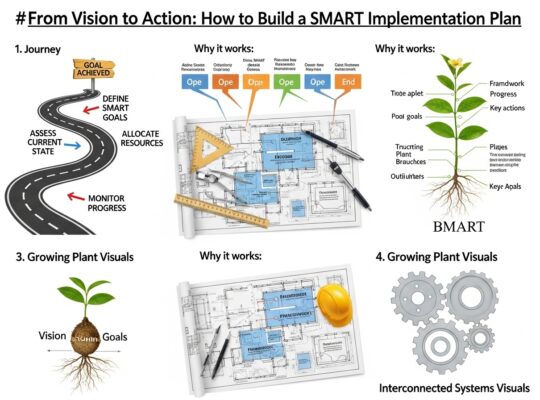
Facilitate workshops or discussions with senior leaders, managers, and front-line employees to identify realistic short- and long-term goals. Make these objectives SMART: Specific, Measurable, Achievable, Relevant, Time-bound. - Formulate and document strategies.
Determine the best strategic approach for reaching your goals. Develop a concrete action plan, outlining responsibilities, timelines, required resources, and key performance indicators. - Execute the plan.
Communicate the strategy clearly across the organisation. Assign clear ownership for each initiative, monitor progress regularly, and remove obstacles to ensure momentum. - Measure results and review progress periodically.
Collect relevant data, review performance against established objectives, and hold regular check-ins (quarterly works well). Use findings to inform any necessary adjustments or course corrections. - Refresh and restart the cycle.
Strategic planning is not static. Close the loop by integrating lessons learned into the next cycle to drive ongoing improvement.
Conclusion
The strategic planning cycle remains a critical discipline for forward-thinking organisations. By treating planning as an ongoing process rather than a one-off event, business leaders can position their organisations to thrive amid uncertainty and complexity. As you reflect on the year gone by, consider how a disciplined, structured cycle can transform grand ambition into tangible, lasting progress for your business.
Key Takeaways
- The strategic planning cycle turns bold vision into actionable plans through repeatable, structured phases.
- Continuous review and adaptation help organisations stay relevant and agile in changing markets.
- Clear objectives, stakeholder engagement, and responsive leadership are essential ingredients for success.
- Documenting and communicating strategy ensures alignment and accountability throughout the organisation.
- Measuring outcomes and learning from each cycle closes the loop, driving ongoing improvement.





[…] A follow-up to “The Strategic Planning Cycle“ […]